
One of the properties open as part of the OpenHouseHobart weekend was Roslyn Estate. This is at the northern end of White Kangaroo Road, off Fingerpost Road, in Campania.
This is now a vineyard, like almost every inch of land in the Coal Valley. The recent vine plantings down this way are beyond astonishing.
We had first visited an 1850s schoolhouse in Dulcot, just south of Richmond, which was part of a State wide exercise which saw prefab schoolhouses placed in many places across the State to give the farm children some formal education. Noel Frankham, whose family include Belbins, Hanslows and Murdochs (not those ones), has turned the Dulcot one into a sensational house with a deck and views to die for.
As if that wasn’t enough, he has recently had moved a 5 room family house, which used to be down on the flats below Dulcot, in 4 pieces up to what may well be called, Upper Dulcot. Also moved were a number of sheds. All these were part of his family’s houses in the 19th Century. As is inevitable, I recently discovered I am (indirectly through the Belbin line) related to Noel’s family.
In a bizarre twist of the planning laws, the new place can be used as an Airbnb, but not for permanent accommodation. Just as well this isn’t a shortage of that.
Next, after a scallop pie in Richmond ( in my view the third best in the State after Exeter – the leader by a mile/1.6 kms – and Ross; I might add that Deloraine Cafe and Bakery was rated minus 1 out of 10 – the curry sauce was ok, but I struggled to find one whole scallop), now where was I , oh yes, we went out to White Kangaroo Road.
I recently discovered, about this time last year, that one of my mum’s direct ancestral lines was to the Hobbs family. She never knew about that. The Hobbs family, headed by the widow, Anne Jane, came out sponsored by my gggggrandfather, William Hopley (husband of Judith Hobbs and father of Julia) on the Calcutta with David Collins. Collins, fairly half heartedly, tried to establish a settlement at Sorrento, in Port Phillip Bay, but with relief, was granted permission to move to the Derwent River. Anyway, as anticipated and indeed expected, the Hobbs girls married the free men on the same ship, as best it could be managed. One of the Hobbs daughers, Jane Anne, married the surveyor, George Prideaux Harris.
Keep with me here.
Harris and Jane had one daughter Eliza. They, by current accounts, had another, Melvina, born after Harris died.
Enter one George Weston Gunning. He arrived in Hobart in 1810, a lieutenant in the 73rd regiment (Lachlan Macquarie’s regiment). He was clearly a favoured son, being sent to restore order in VDL, and being granted land on what is now the Hobart waterfront. His neighbour, I find, was G P Harris and his wife, Anne Jane. Hold that thought.
In 1810, Harris was ill and dying. He died in October 1810. Melvina Harris was born in mid May 1811, and was said to be the posthumous daughter of George Harris. There are some published letters back from Anne Jane to Harris’ mother, some many months later, which seek to comfort her with that information. My direct ancestor, William Hopley, wrote that Anne Jane was pregnant at the time of George’s death.
After Harris’ death, Melvina and Eliza were granted land along White Kangaroo Road, essentially adjacent to George Weston Gunning’s massive land holdings. In 1828, a Moina Gunning died aged 16, the only daughter of Gunning. I have found that in 1828, the same block of land owned by Melvina Harris, became identified as owned by Moina Gunning.
To cut a long story short, there is no doubt in my mind, that Moina and Melvina were the same person, so Moina/Melvina was Gunning’s daughter to Anne Jane Harris, conceived before George died. Certainly by 1812 and 1815, records exist saying Jane Harris was living with Gunning.
Anyhow, this is where the story really starts:
Eliza Harris married George Burn. He had, and continued to have, large blocks above Hamilton, up the Shannon River. As a wedding present, George Weston Gunning gave George and Eliza (Gunning’s step daughter) the property which is Roslyn. Eliza’s original grant south of Roslyn and thus also south of Melvina/Moina’s, is still there as Eliza Farm.
So serendipitously, I was in the region when Roslyn was open to view.
The owner was a fantastic hostess and tour guide. One matter of history I could help with was whether the property known as Campania House, visible from Roslyn, was built in Gunning’s time. I was able to contribute from my research that it was not, but was built by the purchaser of the property from Gunning. Contemporary travel diaries confirm Gunning’s was a small house, called Weston Villa, not the Campania House mansion of today. Gunning in fact went totally off the rails when his daughter died, and the property fell into ruin. I was able to add a fair bit about the region, the families and the properties from my research, which people seemed to find added value.

Roslyn house was originally built in 1823. You can see from the back walls that there were two buildings, one for the family and one for the servants The middle was open, which is evident from the internal walls having windows. Although all the bricks were made across the road (as were all the bricks for early Richmond), there are slight colour differences where the external courtyard was filled in.


The original bell remains, used to call workers in for lunch or to warn of bushrangers. (An interesting aside, David Collins inadvertently created the bushranger problem. When he was swamped by 600 Norfolk Islanders, he had no way to feed them all. So he told them, if they wanted, to head out and range the bush for food. So many did, becoming less hungry the more guns they obtained.)

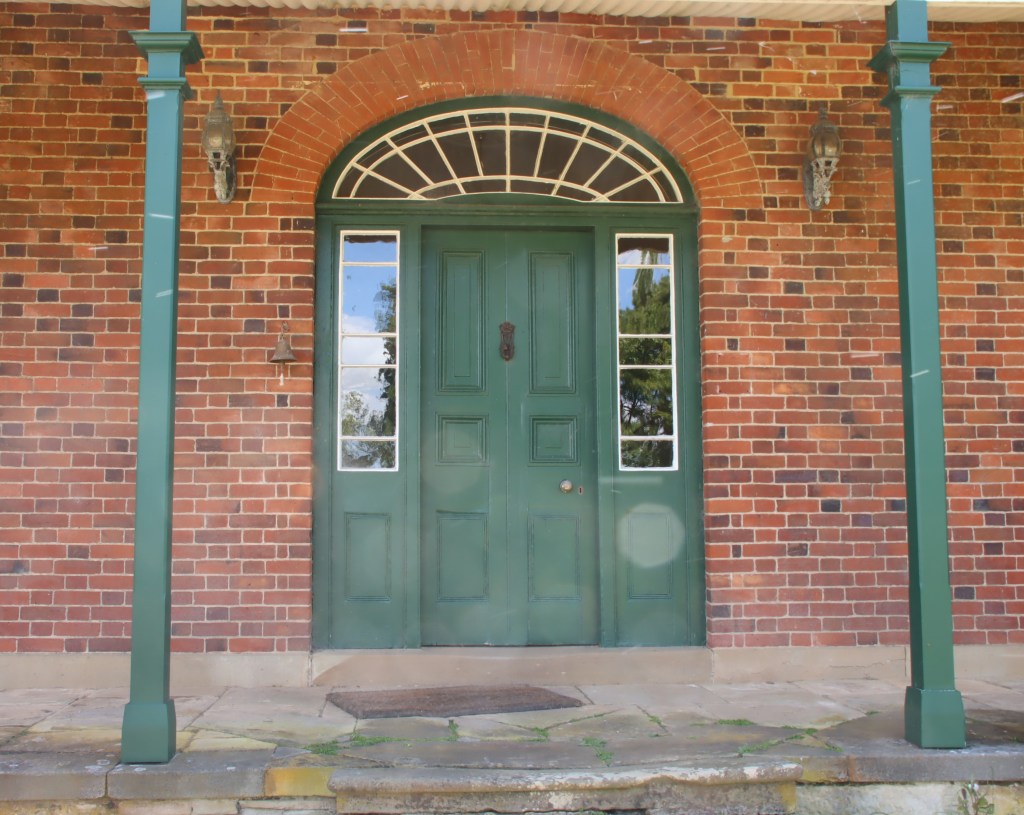
An interesting feature of the house is that the front entrance is grand and designed to impress. The main part of the house is realistically practical.
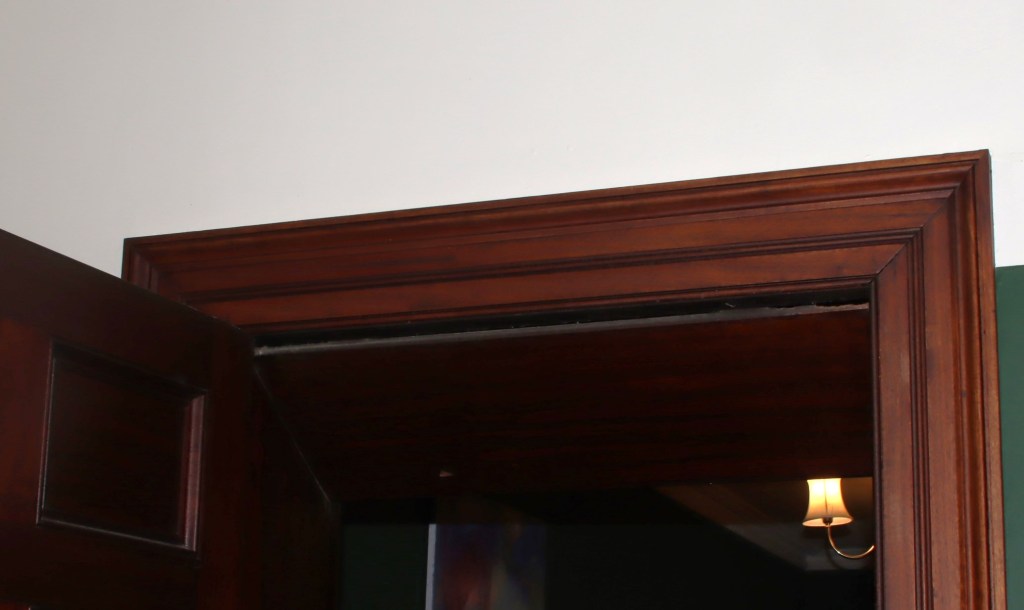
The doors at this end are a good 6 foot high and made of attractive timber. But this is only so for two front rooms. The door jamb from the formal rooms has a slope down, so it hides the fact that all the doors inside that point are significantly lower. Hard to see in the photo but the top of the door jamb slopes significantly down to the further side.
The wine cellar was original. Over $100,000 had been spent by the current owners to ensure water didn’t run into the cellar. Makes you realise the value of the free convict labour.

The original stonework is in remarkably good condition except for a couple of treachorously worn stepping stones.

A very interesting tour, with the only resentful attendee the possum rudely woken from a comfortable sleep in the barn.

Michael Monaghan
November 2024
 Michael Monaghan Photography